


 Back-end
 Mobile App
 Quality Assurance
 DESIGN SERVICES
 FRONT-END
 Digital Marketing Services


 Digital Marketing Expert
WordPress vs Custom Development: What Should Your Business Website Use?

By Ominfowave Team
Friday, October 16, 2026
 60
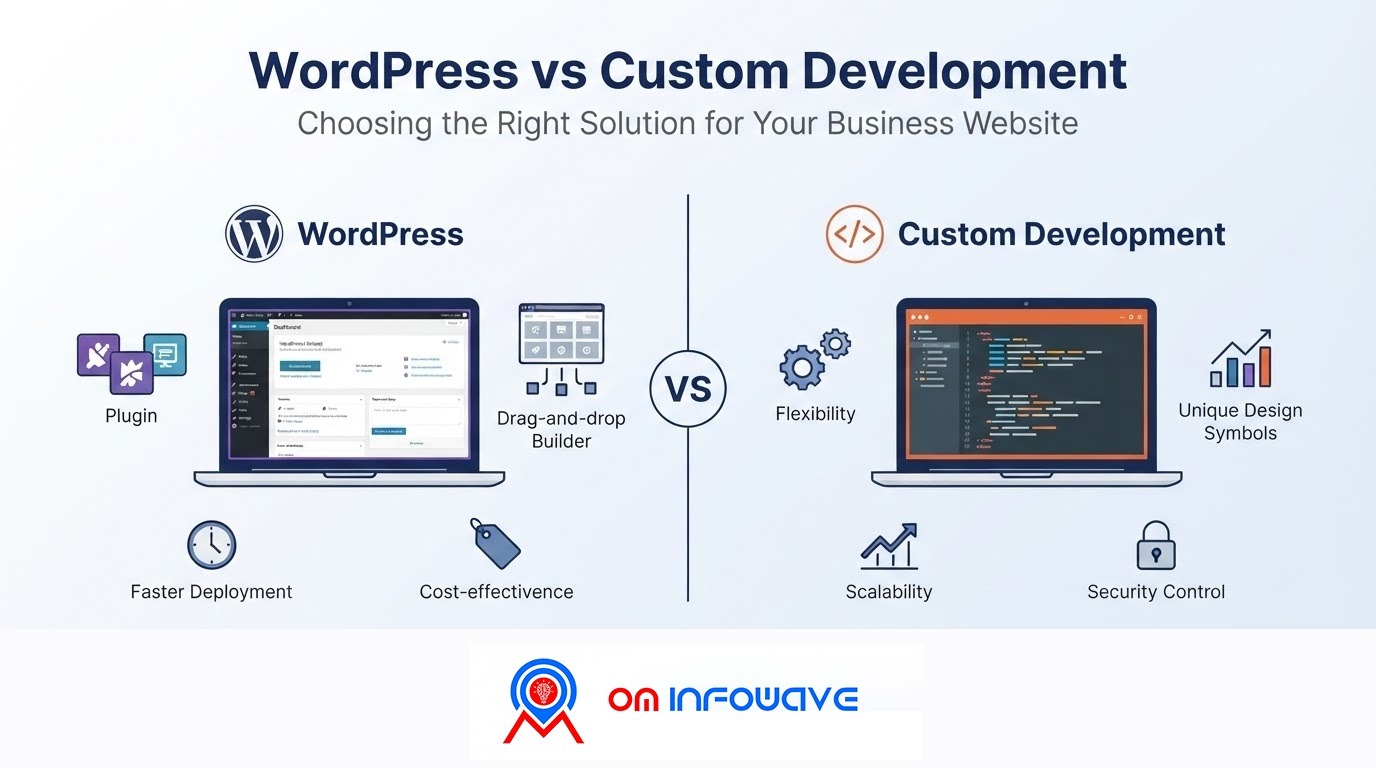
Introduction:
This fast-paced digital era requires unique business ideas and effective online platforms to stand out in the market. A well-designed website can help businesses build an online presence, attract customers, and provide a smooth, user-friendly experience.
When it comes to building a business website, WordPress vs. a custom website are two popular options. But which one is better for your business? Comparing development time, cost, maintenance, customization, and scalability can help you choose the right solution for your needs.
There is no universal answer to which option is best. The right choice depends on your business goals, budget, technical requirements, and long-term plans.
1. WordPress Development
WordPress development services are a popular choice for businesses looking to launch a website quickly and efficiently. WordPress is user-friendly, making it suitable even for people without an IT background. It also offers flexibility through its wide range of themes and plugins, allowing businesses to add features and customize their websites without extensive coding knowledge.
However, WordPress may have limitations when a business requires highly specific functionality. Advanced or unique customization may require additional coding, specialized plugins, or professional technical expertise.
WordPress websites can be built using:
- Ready-made themes for a quick and easy website setup.
- Premium themes customized to match your brand identity.
- Easy-to-use page builders to create and edit website pages.
- Custom plugins and features based on your business needs.
- WooCommerce to set up and manage your online store.
2. Custom Website Development
A custom web development company in India can build a website tailored to your specific business requirements. Unlike template-based solutions, custom development gives you greater control over the website's design, functionality, integrations, and scalability.
Professional developers can build custom websites using technologies such as:
- HTML5 and CSS3: Used to structure and style website pages.
- JavaScript frameworks: React, Vue, and Angular can be used to create interactive and dynamic user interfaces.
- Backend technologies: Node.js, Laravel, and .NET can manage website functionality, business logic, and data.
- Headless CMS: Allows content to be managed separately from the website's front end, offering greater flexibility for certain projects.
Custom development is particularly useful for businesses that need specialized workflows, advanced integrations, unique user experiences, or complex functionality that standard themes and plugins may not provide efficiently.
WordPress vs. Custom Development: Key Differences
Compare the key differences between WordPress and custom website development to determine which option best fits your business goals.
| Factor | WordPress | Custom Development |
|---|---|---|
| Development Time | Usually faster to build | Usually takes more time |
| Cost | Generally more affordable | Usually requires a higher initial investment |
| Content Management | Built-in dashboard makes content updates easier | May require a custom CMS or admin panel |
| Customization | Flexible, but some features depend on themes, plugins, and coding | Highly customizable to business requirements |
| Plugins and Features | Large selection of ready-made plugins | Features can be built for specific business needs |
| Maintenance | Requires updates to WordPress, themes, and plugins | Requires maintenance of custom code and systems |
| E-commerce | WooCommerce simplifies online store setup | Can be tailored to specific e-commerce workflows |
| Complex Requirements | Possible, but may require extra plugins or custom coding | Can be designed around complex business requirements |
WordPress – Cons
Although WordPress offers flexibility and ease of use, businesses should consider its potential limitations:
- Plugin dependency: Some features depend on third-party plugins.
- Security risks: Outdated or poorly maintained plugins and themes can create vulnerabilities.
- Performance issues: Excessive plugins or poorly optimized themes can affect website speed.
- Customization limitations: Complex features may require additional development.
- Regular updates: WordPress core, themes, and plugins need ongoing maintenance.
Custom Development – Cons
Custom development offers greater control, but it also comes with considerations that businesses should evaluate before starting a project:
- Higher development cost: Building features from scratch can require a larger budget.
- Longer development time: Planning, coding, testing, and deployment may take longer.
- Technical expertise: Development and troubleshooting often require skilled professionals.
- Ongoing maintenance: Custom code, integrations, hosting, and security need regular attention.
- Costly feature upgrades: Adding or changing functionality may require additional development work.
Recent Posts
- Website Redesign Checklist: 12 Signs Your Website Needs a Makeover
- How Fast Website Speed Impacts SEO and Conversions
- AI-Powered Test Automation: Catching Bugs Before They Ship in 2026.
- Native vs Hybrid Apps: Which One Should Your Business Choose in 2026?
- How Much Does It Cost to Build a Mobile App for a Startup in 2026?
- Hire Dedicated Developers in 2026: The Smart Business Guide to Scaling Faster & Smarter
- ReactJS vs Other Frameworks in 2026: Why Businesses Still Prefer React
- The Importance of Humans in SEO Today
